How to Calculate GRR: One Formula, Seven Decisions
The GRR formula fits in one line. The number it produces depends on seven decisions most teams never write down. Here's the strict way to make each one.
One line of math
Gross revenue retention is the fraction of last year's recurring revenue you still have today. No upsells, no new logos, just what stayed.
The formula:
GRR = (Starting recurring revenue - churned revenue - contraction revenue) / Starting recurring revenue
Expansion above an account's starting value is excluded, which caps GRR at 100%. A customer who doubled their contract counts the same as one who merely renewed.
The cleaner way to compute it is per account:
GRR = Σ min(ARR of account today, ARR of account 12 months ago) / Σ ARR of all accounts 12 months ago
The sum runs over every account that was paying you 12 months ago. Churned accounts contribute zero to the numerator. Downgraded accounts contribute their reduced amount. Expanded accounts are capped at what they paid before. New customers don't appear anywhere. One warning before you adopt it: this version already bakes in one of the seven decisions below (Decision 4, the big one for multi-product companies).
So why did a 2019 KeyBanc study count 110 different ways companies calculate retention? Why did our pass through public SaaS filings find that even the three companies that publish GRR each attach their own asterisk? Because the formula isn't where the number gets made. The decisions around it are. There are seven.
Decision 1: The window
The standard is 12 months. Compare each account's revenue today against the same account 12 months ago.
The common mistake is computing GRR monthly and then quoting it next to annual benchmarks. Monthly retention compounds: 99% monthly GRR sounds excellent and works out to 88.6% over a year. The team quoting the monthly number and the board reading annual benchmarks are eleven points apart before anything changed in the business.
If you operate on monthly numbers internally, fine, but convert before you compare: annual GRR is roughly monthly GRR to the 12th power. (Slightly conservative, since accounts that dip and recover count against the monthly chain but not the annual snapshot.) And label which one you're quoting, every time.
Decision 2: Snapshot or smoothed
The strict version is a point-in-time snapshot: this month's cohort revenue against the same cohort 12 months ago. It's volatile, and that volatility is information. A big logo churning should be a visible step down in the chart, and an average dissolves it.
The alternative is trailing-12-month (TTM) smoothing, where you average the monthly snapshots. Ordway's study of 135 public SaaS companies found 29% of the companies disclosing net retention smooth this way, and the same habit shows up in gross numbers. Smoothing is defensible for board reporting on a small customer base, where one logo swings the number by points. It shouldn't be the only version you look at, because it spreads one month's bad news across twelve months of reporting; the full size of a churn event doesn't show for a year.
Our recommendation: track the snapshot, report the snapshot, and show the TTM line next to it if your base is under a few hundred accounts.
Decision 3: The unit of revenue
Use contracted recurring revenue, ARR or MRR, not GAAP revenue. GAAP revenue drags in recognition timing, one-time services, and deferred revenue mechanics that have nothing to do with whether customers stayed.
Usage-based pricing makes this harder, since there's no fixed contract value to compare. The practical options are committed spend (compare contract commitments) or trailing usage (each account's trailing-3-month run rate now versus 12 months ago). Pick one. The failure mode is mixing them, committed for some accounts and usage for others, which makes the number impossible to audit.
Ramp deals force one more definition: is an account's ARR the rate it bills today, or the committed rate in the contract? A deal contracted to step from $50K to $100K looks like expansion under billing-rate ARR and flat under committed ARR. Either convention works, as long as both ends of the 12-month comparison use the same one. Mix them and contracted step-ups start showing up as retention events.
One-time revenue, implementation fees, and services stay out of both the numerator and the denominator.
Decision 4: Where you net
For multi-product companies, this decision can move the number more than any other, and almost nobody writes it down.
Suppose an account pays $2,000/month for product A and drops it, but in the same year adds product B for $2,500/month. Did that account churn $2,000, or did it grow?
- Line level (strict): you lost $2,000 of retained revenue. The new product is expansion, and expansion doesn't count in GRR. The account contributes $0 retained from product A.
- Account level: the account pays more than before, so it retained 100% of its starting value (capped). Nothing churned.
The per-account min() formula above is account-level netting. It's the common standard and what most buyers will accept, but understand that it's the more generous of the two: it lets a cross-sell absorb a product churn inside the same account. If you want the truly strict number, compute line-level GRR alongside it. And notice that account-level netting quietly does what Vertex, one of the three public GRR disclosers, does out loud: its definition excludes cancellations that are "replaced by new subscriptions associated with customer migrations to a newer version" of the product. If your method or your carve-out converts product churn into a non-event, write it in the definition, because a diligence team will find it.
Netting also depends on where the account boundary sits. Parent company or contracting entity? A subsidiary downgrading while its parent expands is contraction under one hierarchy and invisible under the other. Pick a level, freeze the hierarchy at the start of the period, and apply it everywhere.
What you cannot do is net across accounts. Expansion at customer X never offsets churn at customer Y. The moment it does, you're computing NRR and calling it GRR.
Decision 5: What counts as churn
Everything that stops paying. Specifically:
- Involuntary churn counts. Failed payments, expired cards, and unreachable billing contacts are churn. "They didn't mean to leave" doesn't return the revenue.
- Downgrades count as contraction. The classic inflation trick in private SaaS is computing "churn" as full cancellations only, so a customer who cut their contract from $50K to $10K registers as retained. Strict GRR counts the $40K.
- Pauses and win-backs need a written rule, because the min() formula alone won't catch them. An account that pauses in month 4 and returns at full price by month 12 scores min(full, full), and the round trip vanishes. The strict treatment: once an account churns or pauses to zero inside the window, its return is new business. It contributes nothing to the numerator, even if it's back at full price on the snapshot date.
- Credits and write-offs count. A service credit that cuts what an account actually pays this period is contraction, whatever the contract says. And an invoice you'll never collect isn't retained revenue: treat sustained non-payment like involuntary churn instead of letting bad debt sit in the numerator because the contract is technically live.
- Discounts to save an account count. If you cut a renewal price 30% to keep the logo, you retained 70% of the dollars. Logo retention and dollar retention are different metrics; GRR is the dollar one.
One more timing rule: decide when churn hits the number, the day the customer gives notice or the day the contract ends and billing stops. Strict GRR uses the contract end date, since the revenue is real and collectible until then. But log notice dates separately, because a widening gap between notified churn and recognized churn means the metric is smiling while the queue of departures builds.
Decision 6: Who is in the cohort
Everyone who was paying 12 months ago. The strict answer has no exclusions, and every exclusion you allow moves the number up.
The public disclosers show how exclusions creep in: Workday excludes certain contracts shorter than one year from its GRR. Zoom's net retention covers enterprise customers only. Each exclusion is disclosed and sounds reasonable on its own, and each one removes the customers most likely to leave.
Watch for a cousin metric that travels under a similar name: gross renewal rate, computed only on contracts that were actually up for renewal during the period. That available-to-renew base quietly drops every contract that couldn't leave, which is exactly the population guaranteed to retain. GRR's denominator is everyone who was paying 12 months ago, renewal date or not. When someone hands you a retention number, ask which base it's on before comparing it to anything in this post.
Multi-year deals flatter GRR the same way while they run. A three-year contract in year two can't churn no matter how unhappy the customer is, so a base that's 60% multi-year can print 97% right up to the renewal cliff. Track what share of your starting cohort was actually able to leave during the window, and compute GRR on that slice too. If the blended number and the could-have-left number are far apart, the headline is measuring contract terms, not satisfaction.
If you must segment, and for a business with self-serve and enterprise motions you probably should, report the segments alongside the blended number. The blended number stays.
Decision 7: Currency and corporate events
The last decision is what you adjust for. Two adjustments are legitimate, as long as they're written down:
- Currency. If you bill in multiple currencies, a strict GRR moves when exchange rates move. Workday computes GRR on constant currency, with rates frozen at the start of the fiscal year. That's reasonable, as long as the same treatment applies every period.
- M&A and divestitures. Blackbaud's gross retention improved to roughly 92% in fiscal 2025 "primarily due to our sale of EVERFI," per its own 10-K. Selling a leaky division raises GRR without a single customer staying longer. Divested accounts come out of both endpoints, retroactively. Acquired accounts have no "12 months ago" with you, so they enter the cohort once they have 12 months of owned history; backdating them into the starting base pads the number with revenue that never had a chance to churn on your watch.
A worked example
A company starts the year with 40 customers and $100,000 in MRR. Over the next 12 months:
- 4 customers churn, worth $8,000 of starting MRR (one of them a failed card; Decision 5 says it counts)
- 3 customers downgrade, cutting a total of $4,000 (Decision 5 again: every dollar of downgrade counts, not just full cancellations)
- 6 customers expand, adding $15,000
Revenue from that starting cohort is now $103,000, so NRR is 103%. Above water, decent slide.
GRR is ($100,000 - $8,000 - $4,000) / $100,000 = 88%. Whether that's good depends on which benchmark you grade it against. Benchmarkit's 2026 report puts the private B2B SaaS median at 84%, down from 88% a year earlier. SaaS Capital's 2023 survey measured 91%. The same 88% sits above one median and below the other, which is one more reason to name the survey and the year every time you quote a benchmark. Either way, this company leaks 12% of its base a year and covers it with upsells. NRR says it's fine. GRR says look closer. Both are true; they answer different questions.
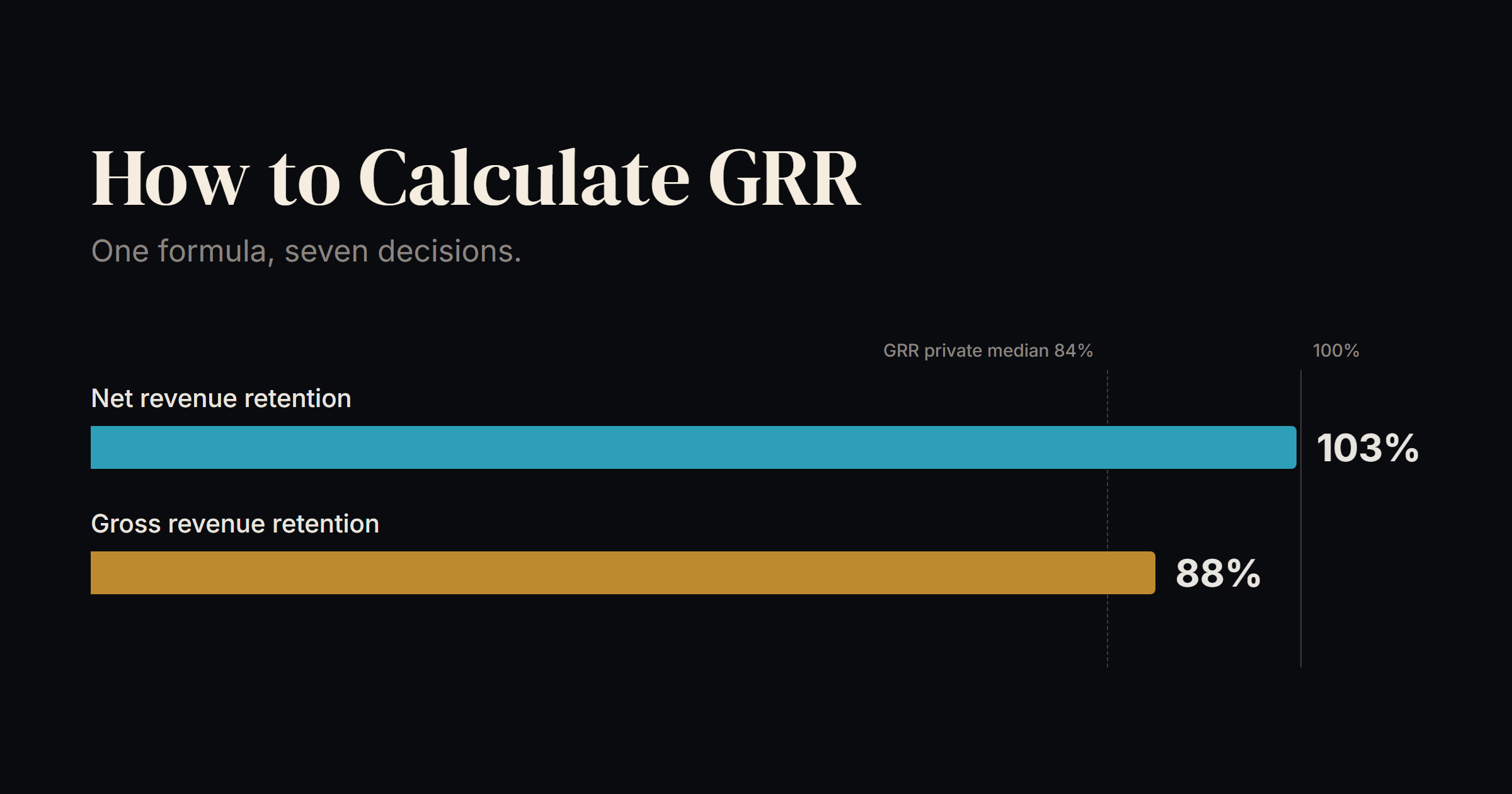
Expansion keeps NRR looking healthy right up until the expansion runs out. GRR tells you what's underneath before that happens.
The strict recipe, in one block
Copy this into your metrics documentation and adjust the choices:
Gross revenue retention (dollar-based, annual) For every account with active recurring revenue 12 months ago: sum min(current ARR, ARR 12 months ago), divided by total ARR of those accounts 12 months ago. Current ARR measured on the last calendar day of the month.
- Window: 12-month point-in-time snapshot, computed monthly. TTM average shown alongside, never alone.
- Unit: contracted ARR. Ramp deals at billing rate, both endpoints. Usage-based accounts at trailing-3-month run rate, annualized, both endpoints; hybrid accounts at committed value plus trailing overage, both endpoints. No services, no one-time fees.
- Netting: within account only, capped at starting value. Never across accounts. Accounts defined at the contracting entity, hierarchy frozen at period start.
- Churn and contraction: include involuntary churn, credits, write-offs, downgrades, and renewal discounts. Churn recognized at contract end date, notice dates logged separately. An account not billing on the snapshot date carries $0 current ARR regardless of contract status, and an account that churned inside the window counts zero even if reactivated.
- Cohort: all paying accounts, no exclusions, full base (not available-to-renew). Segments and a could-have-left cut reported in addition to blended, not instead.
- Currency: constant currency, rates frozen at fiscal year start, refreshed annually. M&A: divested accounts removed from both endpoints; acquired accounts enter after 12 months of owned history.
The specific choices matter less than writing them in one place and applying them the same way every period. When definitions live in nobody's head and everybody's dashboards, the numbers drift, and retention definitions drift in one direction in practice: up.
What good looks like
For calibration, two surveys of private B2B SaaS: Benchmarkit's 2026 report puts median GRR at 84%, down from 88% a year earlier, with the 75th percentile at 91%. SaaS Capital's 2023 survey measured a 91% median (NRR 102%). Part of the gap is time (the 2026 report points at renewal pushback and AI-driven seat shrinkage) and part is sample, which is the benchmark lesson in miniature: name the survey and the year, or you're comparing against nothing. The three public companies that currently publish GRR sit between 92% and 97%, and remember the selection effect, since the companies willing to print the number are the ones the number flatters. Two grains of salt on all of these: they're survey self-reports, so respondents weren't using this strict recipe, and retention runs higher with bigger contracts, so calibrate to your ACV band if you can.
If your strict, no-carve-out GRR clears the 84% median, you're holding better than the typical private peer in 2026. If it clears 91%, you're in the top quartile and retention is a strength you should be talking about. And if it only clears those bars with the carve-outs in place, you don't have a retention number, you have a negotiation position.
If you'd rather have your retention definition stress-tested before a diligence team does it for you, that's the kind of work we do.